Home › Equipment › Scaffolding
Scaffolding hire in Spain
Scaffolding in Spain is priced and contracted differently from the UK: by the square metre of facade, by the month rather than the week, and almost always erected by the supplier's own crew rather than dropped off for you. Send us the facade dimensions and the job and we come back with up to 3 quotes you can compare on the same basis.
Typical models
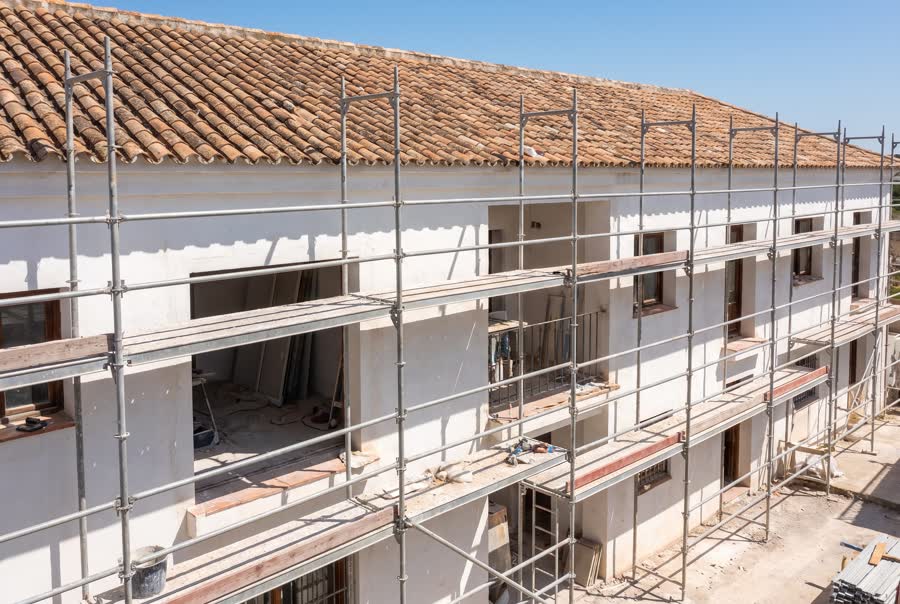
Facade scaffolding
- Priced by: m² of facade per month
- Erection: By the supplier's crew
- Minimum period: Typically one month
- Typical use: Render, paint, repair
€6/m² per month
Check availabilityAluminium mobile tower
- Working height: Typically up to 8 m
- Erection: Self-assembled on site
- Mobility: Castors, moved by hand
- Typical use: Short indoor and outdoor jobs
€25/day
Check availabilityPrices 2026
How much does scaffolding cost in Spain?
Facade scaffolding in Spain costs from €6 to €12 per square metre per month excluding VAT, with erection, dismantling and transport quoted separately; a mobile aluminium tower is €25–45 per day or €220–400 per month, and 21% IVA is added at invoice.
| Type | Day | Week | Month | Deposit |
|---|---|---|---|---|
| Facade scaffolding | — | — | €6–12 per m² | per contract |
| Aluminium mobile tower | €25–45 | €90–160 | €220–400 | €200–500 |
Indicative market prices excluding VAT (21% IVA). Facade scaffolding is billed per square metre of elevation per month; erection, dismantling and transport are separate lines. Transport is typically €100–250 per journey.
How Spanish scaffolding pricing differs from the UK
If you have hired scaffolding in Britain, the mental model you bring will mislead you in three specific ways. None of them mean you are being overcharged; they mean you are comparing different things.
Per square metre, per month
Spanish facade scaffolding is quoted as €6–12 per m² of elevation per month, not as a lump sum for a job of a given duration. The area is the face of the building being covered — length along the wall multiplied by height — so a facade 10 m wide and 9 m high is 90 m², which at €8/m² is €720 for the month before erection and transport. Get the dimensions right before requesting quotes, because everything else follows from them.
Monthly, not weekly
The UK norm of a weekly hire period barely exists here. The billing unit is the month, and the first month is generally the minimum. That has a practical consequence worth planning around: a job that overruns by four days often costs you a further whole month of hire. Conversely, if you have several pieces of work to do on the same elevation — render, then paint, then guttering — it is far cheaper to sequence them inside one hire period than to erect the scaffold twice.
Erection is a separate line, and it is not optional
You do not hire the components and put them up yourself. The supplier's crew erects and dismantles the scaffold, and that labour is quoted as its own line item, usually alongside transport. This is why two quotes with the same €/m² can differ substantially in total. When you compare offers, insist on four separate figures: hire per m² per month, erection, dismantling and transport. A single bundled number cannot be compared with anything.
Facade work: what scaffolding is actually for here
On the Spanish coast the overwhelming majority of scaffolding goes up for facade repair, and the reasons are consistent enough to be predictable.
Render and repainting
Spanish buildings are typically rendered and painted rather than faced in brick, and coastal render has a hard life: salt, sun, thermal movement and driven rain. Render cracks, blows and stains, and the fix is to strip the failed sections, repair and repaint the whole elevation so the finish matches. That is a whole-facade job by definition, which is why it is scaffolded rather than done off a platform — the crew needs to be on the wall for days with materials to hand.
Balconies, rails and roof edges
Reinforcement corrosion in balcony slabs and rusting rail fixings are among the most common structural repairs on the coast, and they demand steady access along the full elevation. Roof-edge work — replacing tiles at the eaves, guttering, flashing — sits in the same category. For these, a scaffold is safer and far more productive than a cherry picker precisely because the work is repetitive along a line rather than concentrated at one point.
Scaffold or access platform?
The honest rule of thumb: if the work lasts more than a few days and runs along the facade, scaffold it. If it is a single point and a short job, hire an access platform instead. A 12–16 m articulated boom at €90–230 per day beats a scaffold for changing a light, fixing a sign or a one-day repair. For a month of render work across an entire elevation, scaffolding at €6–12/m² per month is dramatically cheaper and the crew works far faster from a fixed deck. There is also a legal dimension: an access platform brings the PEMP training obligations under RD 1215/1997, whereas a scaffold erected by the supplier's certified crew does not put your people in a machine at all.
Who is allowed to erect it, and what you should receive
Scaffolding in Spain is regulated work equipment and is covered by RD 1215/1997 on work equipment, including its provisions on temporary work at height. In practice this means the scaffold must be erected, altered and dismantled by trained people under qualified supervision, and for larger or more complex structures an assembly plan is required. This is not a formality you can wave away by asking for the parts to be dropped off.
What a proper supplier provides
- An erection crew with the relevant training, doing the assembly and the dismantling.
- A handover confirming the scaffold is complete and fit for use before anyone works from it.
- Documentation for the site file where the works are formal — the assembly arrangement, the equipment's own certification and the crew's competence.
- Inspection after events that could have affected stability, such as strong winds or a modification.
What you must not do
Do not let a trade alter the scaffold to suit themselves. Removing a guardrail or a board to get a window open, adding a plank across a gap or shifting a tie is exactly how scaffold accidents happen, and it voids the supplier's handover. If the configuration does not work, call the supplier back to modify it — a visit is inexpensive compared with the alternative.
Insurance
The structure is insured by its owner, but that does not cover damage you cause or the consequences of unauthorised modification. If a UK-issued liability policy is your only cover, check that it extends to works in Spain before the scaffold goes up.
Permissions: community, street and neighbours
The paperwork, not the scaffold, is what usually delays a Spanish facade job. Start it before you confirm dates, because a scaffold standing idle still bills by the month.
Your community of owners
If the property is in a comunidad de propietarios — which covers most apartments and the great majority of coastal urbanisations — the facade and the ground around it are typically common property. Anything standing on common ground, oversailing a shared path or blocking a communal access road needs the community's agreement, obtained in writing from the administrator. Expect this to take days rather than hours, and longer if it requires a decision from the president or a meeting. Ask at the same time about permitted working hours: restrictions over the long lunch period and at weekends are near-universal, and they affect how many months of hire you end up paying for.
Public land and the town hall
Where the scaffold stands on a pavement, a public street or above one, you are occupying public land and the town hall's permission is required — a licence for occupation of public space, with its own fee and its own processing time, which varies from one municipality to the next. This applies far more often than owners expect, because on narrow streets in old town centres there is nowhere else to put the base. If your property fronts directly onto a street rather than sitting inside its own plot, assume you need it and ask early.
Neighbours and access
Facade work on a shared building affects everybody's windows, light and privacy for a month or more. Telling neighbours before the crew arrives costs nothing and avoids complaints that can stop the job. If the scaffold needs to cross or be tied into a neighbouring property, that needs their consent too — and it is far easier to obtain before the structure is half built.
Getting an accurate quote and where we deliver
Scaffolding is the category where a vague enquiry produces the most useless quotes, because everything depends on measurements the supplier cannot guess.
What to send
Give the length and height of each elevation to be covered, the work being done, an honest duration, the ground conditions at the base (paving, soil, terrace, sloping), and whether there are obstacles — balconies, canopies, a pool, a lean-to. Photographs of each elevation from a distance are worth more than any description. Say clearly whether the base stands on your own land, on community land or on a public street, because that changes the permissions and sometimes the design.
Compare like with like
Ask every supplier for the same four lines: hire per m² per month, erection, dismantling and transport. Then check two more things: what happens if you need an extra month (the renewal rate is usually lower than the first month, but confirm it), and what an amendment visit costs if the configuration needs changing mid-job.
Where we can deliver
On the Costa del Sol, suppliers based around Málaga and the Guadalhorce valley serve Marbella, San Pedro, Estepona, Benahavís, Mijas, Fuengirola and Benalmádena — a market driven almost entirely by render and balcony repair on urbanisation blocks and villas. On the Costa Blanca, yards around Alicante, Elche, Torrevieja, Benidorm and Dénia cover the coast from Pilar de la Horadada to Jávea, where salt-damaged render and roof-edge work dominate. Because scaffolding is erected rather than delivered and collected, the crew's travel is a bigger factor than for machine hire: a nearer supplier is frequently cheaper overall even at a higher rate per square metre. Send us the postcode and the elevation dimensions and we will match you to suppliers who genuinely cover your area.
FAQ
Scaffolding — Common questions
How much does scaffolding cost in Spain?
Facade scaffolding is €6–12 per square metre of elevation per month excluding VAT, with erection, dismantling and transport quoted separately. A facade 10 m wide and 9 m high is 90 m², so around €540–1,080 for the first month before those extras. A mobile aluminium tower is €25–45 per day or €220–400 per month. 21% IVA is added at invoice.
Why is Spanish scaffolding priced per month rather than per week?
Because the market convention here is monthly hire, with the first month usually the minimum. It reflects the typical job — a full facade being rendered or repainted, which takes weeks rather than days. The practical implication is that an overrun of a few days can cost a further whole month, so it pays to sequence all the work on one elevation inside a single hire period.
Can I erect the scaffolding myself?
No. Scaffolding is regulated work equipment under RD 1215/1997, and it must be erected, altered and dismantled by trained personnel under qualified supervision, with an assembly plan for larger structures. Suppliers quote erection and dismantling as separate line items and send their own crew. Mobile aluminium towers are the exception, being designed for on-site assembly by the user.
Do I need permission from my community of owners?
Almost certainly, if the scaffold stands on or oversails common areas or blocks a shared access road, which on coastal urbanisations it usually does. Get the administrator's agreement in writing before confirming dates, and ask about permitted working hours at the same time. Allow days rather than hours, and longer if a decision from the president or a meeting is needed.
Do I need a town hall licence for scaffolding on the street?
Yes. Standing on or over a pavement or public street is occupation of public land and requires a licence from the town hall, with its own fee and processing time that varies by municipality. It applies more often than owners expect, particularly in old town centres where there is nowhere else to put the base. Ask about it at the quote stage.
Should I hire scaffolding or a cherry picker?
If the work runs along the facade and lasts more than a few days, scaffold it — a crew works far faster from a fixed deck and €6–12/m² per month beats daily platform hire over a month. If it is a single point and a short job, an articulated boom at €90–230 per day is cheaper and quicker to organise. A platform also brings PEMP operator training obligations that a scaffold erected by the supplier's crew does not.
What is included in the price and what is extra?
The €/m² figure is the hire of the structure. Erection, dismantling and transport are separate, and transport is typically €100–250 per journey. Netting or sheeting, protective fans over an entrance, amendment visits and any additional month are also priced separately. Ask for all four core lines itemised so you can compare offers on the same basis.
How long does it take to erect facade scaffolding?
For a typical residential elevation, erection is usually a matter of a day or so once the crew is on site — the delay in a Spanish facade job is almost always the permissions, not the scaffold. Community consent and, where the base sits on public land, the town hall licence should be started well before you want the crew to arrive.
Do these prices include VAT?
No. All figures are excluding VAT, which is standard for equipment hire in Spain, and 21% IVA is added at invoice. British customers used to inclusive pricing should budget accordingly. If you are registered as a business or self-employed in Spain, that VAT is recoverable against a proper tax invoice.
What happens if a trade needs to move part of the scaffold?
Call the supplier back to modify it. Removing a guardrail or board, bridging a gap with a loose plank or shifting a tie is how scaffold accidents happen and it voids the supplier's handover of the structure. An amendment visit is inexpensive relative to the risk, and it keeps the documentation for the works valid.
Local coverage
Scaffolding hire in Spain — Other locations
Ready? Request a quote in one minute.
Up to 3 quotes from local suppliers. Free, no obligation.